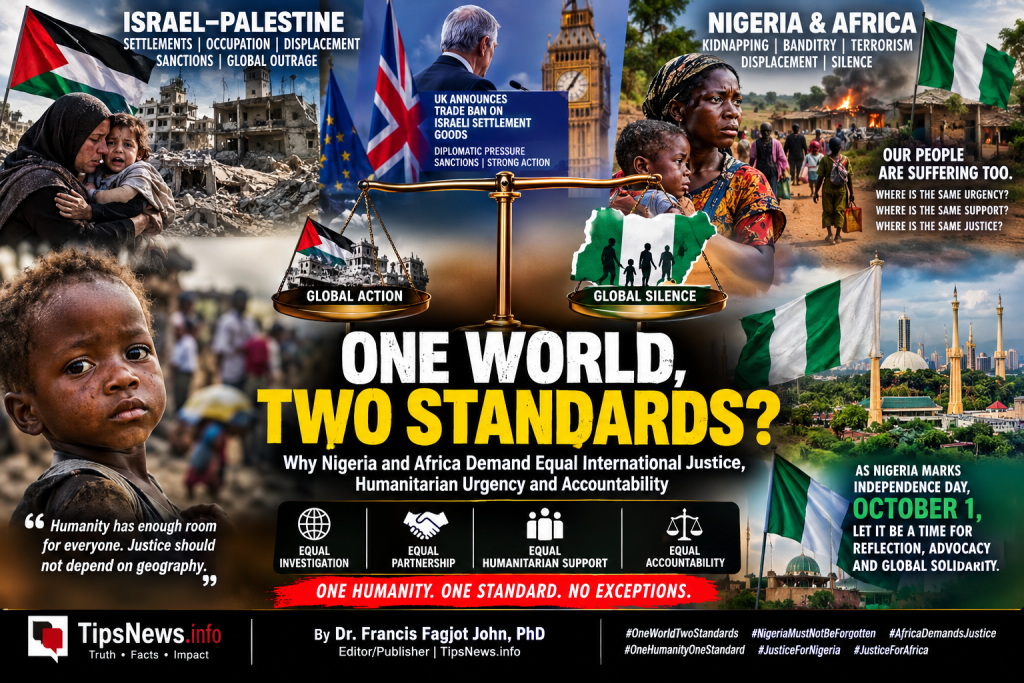
ONE HUMANITY, ONE STANDARD: WHY THE WORLD MUST RECONSIDER NIGERIA BEFORE AFRICA RECONFIGURES THE GLOBAL ORDER
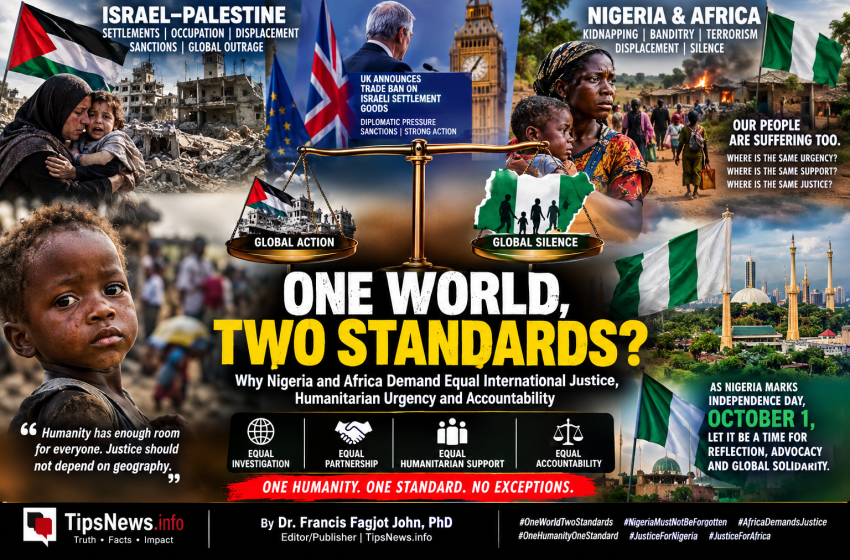
ONE HUMANITY, ONE STANDARD: WHY THE WORLD MUST RECONSIDER NIGERIA BEFORE AFRICA RECONFIGURES THE GLOBAL ORDER
By Francis Fagjot John, PhD Editor/Publisher | TipsNews.info
INTRODUCTION: WHEN THE WORLD FINDS ITS VOICE IN ONE PLACE AND LOSES IT IN ANOTHER
The global diplomatic landscape is currently gripped by significant high-stakes confrontations involving Britain, Israel, Palestine, and the occupied West Bank.
Britain and its allied nations have adopted increasingly assertive stances regarding Israeli settlement activities. Through proposed economic restrictions, trade policy adjustments, and coordinated multilateral declarations tied to occupied Palestinian territory, these powers have demonstrated what is possible when geopolitical momentum aligns with humanitarian rhetoric. These actions have ignited intense global debates over forced displacement, military occupation, and international law as codified by institutions like the United Nations International Court of Justice.
The reported decisions regarding trade restrictions and the subsequent diplomatic friction surrounding foreign presence in East Jerusalem reveal an unequivocal truth:
- When powerful governments decide that international law, civilian protection, and human rights are at stake, they possess the capacity to act.
- They issue immediate joint communiqués.
- They coordinate international sanctions and economic levers.
- They mobilize multilateral pressure within hours.
- They place humanitarian imperatives at the absolute center of global policy.
Yet, from Nigeria—and across the broader African continent—a profound, uncomfortable question echoes:
Where is this same level of urgency when African communities are systematically attacked, displaced, impoverished, and erased?
Where are the emergency international coalitions for the Lake Chad Basin? Where is the sustained diplomatic pressure on cross-border terror financiers? Where are the coordinated global intelligence architectures tracking the illicit money flows behind organized kidnapping and mass massacres?
This editorial does not aim to diminish Palestinian suffering, minimize Israeli security concerns, or establish a cynical competition between victims. It exists to pose a foundational question to the international order: Does global justice operate on a universal standard, or does human dignity retain a geopolitical hierarchy?
THE COMPARISON MUST BE MADE CAREFULLY
Intellectual honesty demands clarity. The Israeli-Palestinian conflict and Nigeria’s domestic security crisis are distinct in their political structures and historical trajectories.
The Middle Eastern crisis involves decades of state-level geopolitical friction, disputed sovereignty, military occupation, and formal state policy. Nigeria’s insecurity, by contrast, is a complex, highly asymmetric, and fragmented web. It includes:
- Transnational Terrorism: Violent extremist organizations operating across borders.
- Armed Banditry & Kidnapping: High-yield criminal networks destabilizing rural economies.
- Communal & Resource Conflicts: Climate-driven competition over fertile land and water corridors.
- Institutional Challenges: Corruption, border vulnerabilities, and stretched security apparatuses.
       ┌────────────────────────────────────────────────────────┐
       │             THE CONVERGENCE OF DISPLACEMENT            │
       └───────────────────────────┬────────────────────────────┘
                                   │
         ┌─────────────────────────┴─────────────────────────┐
         ▼                                                   ▼
┌─────────────────────────┐                         ┌─────────────────────────┐
│     THE WEST BANK       │                         │        NIGERIA          │
├─────────────────────────┤                         ├─────────────────────────┤
│ • State-Led Policy      │                         │ • Criminal/Terrorist    │
│ • Geopolitical Conflict │   HUMAN CONSEQUENCE:    │   Asymmetric Warfare    │
│ • Military Occupation   │  ► Forced Displacement  │ • Resource Competition  │
│ • Formal Settlement     │  ► Loss of Ancestral    │ • Weak Governance       │
│ • International Law     │     Land & Livelihood   │   Structures            │
│   Focus                 │  ► Systemic Trauma      │ • Illicit Financial     │
│                         │  ► Economic Ruin        │   Flows                 │
└─────────────────────────┘                         └─────────────────────────┘
While structural origins differ, the human fallout is indistinguishable. A mother running from gunfire in Benue State or Plateau State experiences the same terror as a mother displaced in the West Bank. A farmer cut off from his ancestral land in Northern Nigeria suffers the same economic degradation as a farmer whose olive groves are destroyed.
Human agony does not become secondary simply because it unfolds under African skies.
LAND GRABBING, DISPLACEMENT, AND THE IMPERATIVE FOR EQUAL INVESTIGATION
Legal terms like “ethnic cleansing” or “systemic demographic engineering” carry heavy international legal weight under frameworks established by the International Criminal Court. They must never be deployed casually. Not every violent dispute represents a coordinated demographic agenda; many stem from environmental degradation, desertification, and governance collapse.
However, when civil society organizations, local leaders, and human rights watchdogs consistently document targeted village destructions, permanent displacement, and the occupation of abandoned farmland, the world cannot look away.
If allegations of structural displacement and targeted violence merit immediate, high-level international fact-finding missions in Eastern Europe or the Middle East, they demand identical international scrutiny in Nigeria. Nigeria should not have to prove its citizens are human enough to warrant an investigation.
THE EVIDENCE IS ALREADY THERE
Nigeria does not need to manufacture a crisis to capture global headlines. The data documented by organizations like the International Organization for Migration (IOM) and the UN Refugee Agency (UNHCR) is clear:
┌──────────────────────────────────────────────────────────────────────────┐
│                   NIGERIA SECURITY & HUMANITARIAN DATA                   │
├───────────────────────────────┬──────────────────────────────────────────┤
│ Internally Displaced Persons  │ Over 3.3 Million Regionally              │
├───────────────────────────────┼──────────────────────────────────────────┤
│ Agricultural Land Abandonment │ Hundreds of Thousands of Hectares Unfarmed│
├───────────────────────────────┼──────────────────────────────────────────┤
│ Primary Insecurity Vectors    │ Banditry, Terrorism, Organized Kidnapping│
└───────────────────────────────┴──────────────────────────────────────────┘
The issue is not a lack of evidence; it is a lack of global political will.
GEOPOLITICAL INTERESTS vs. UNIVERSAL HUMAN RIGHTS
Why does the Middle East command global urgency while African crises suffer from diplomatic fatigue? The answer lies in the cold calculus of realpolitik.
The Middle East sits at the intersection of international trade routes, energy corridors, strategic military alliances, and major power rivalries. Africa, despite its vast demographic trajectory, critical mineral wealth, and strategic importance, is often treated by Western capitals through a transactional lens—engaging primarily when crises spark mass migration or threaten direct resource extraction.
This dynamic breeds a dangerous perception: the strategic utility of your geography dictates the value of your life.
               ┌──────────────────────────────────────────────┐
               │         GLOBAL DIPLOMATIC DYNAMICS           │
               └──────────────────────┬───────────────────────┘
                                      │
           ┌──────────────────────────┴──────────────────────────┐
           ▼                                                     ▼
┌──────────────────────────────┐                       ┌──────────────────────────┐
│     HIGH-PRIORITY REGIONS    │                       │  STRUCTURAL MARGINALIZATION│
├──────────────────────────────┤                       ├──────────────────────────┤
│ • Emergency UN Summits       │                       │ • Periodic Statements    │
│ • Swift Economic Sanctions   │   THE GEOPOLITICAL    │ • Delayed Aid Appeals    │
│ • Daily Global Headlines     │     HIERARCHY         │ • Minimal Media Focus    │
│ • Coordinated Task Forces    │                       │ • Limited Financial Tracking│
└──────────────────────────────┘                       └──────────────────────────┘
When Western powers like Britain, Canada, France, and the United States engage with Nigeria, the collaboration often remains confined to standard development assistance or limited military training. But true partnership requires tracking the financial networks—often touching foreign banking systems—that sustain terrorism and illegal arms flows across the Sahel.
THE INTERNAL IMPERATIVE: NIGERIA MUST ACCEPT RESPONSIBILITY
External inaction does not excuse internal governance failure. Sovereignty is not merely a shield against foreign interference; it is a solemn contract to protect citizens.
The Nigerian state must take primary ownership of its destiny. International assistance can complement, but never replace, internal reform. The domestic agenda must focus on:
- Intelligence Integration: Dismantling structural silos across military and civil security agencies.
- Financial Tracking: Unmasking high-profile sponsors of kidnapping and terrorism within domestic borders.
- Judicial Efficiency: Swiftly prosecuting captured warlords and terror coordinators to restore public faith in the rule of law.
- Border & Territorial Control: Securing rural spaces to allow farming communities to return safely.
WHEN NIGERIA BREAKS, AFRICA FEELS IT—AND THE WORLD WILL FOLLOW
The international community must grasp a fundamental strategic reality: Nigeria is the pillar of African stability.
With a population projected to exceed 370 million by 2050, Nigeria is not simply another nation; it is the economic engine, demographic heart, and security anchor of West Africa.
┌─────────────────────────────────────────────────────────────────────────┐
│                      THE RIPPLE EFFECT OF NIGERIA                       │
├─────────────────────────────────────────────────────────────────────────┤
│                                                                         │
│  ┌──────────────────┐      ┌──────────────────┐      ┌───────────────┐  │
│  │     NIGERIA      │ ───► │    WEST AFRICA   │ ───► │ GLOBAL IMPACT │  │
│  │   Instability    │      │ Resilient Collapse│      │ Migration &   │
│  │                  │      │  & Trade Shock   │      │ Market Crises │
│  └──────────────────┘      └──────────────────┘      └───────────────┘  │
│                                                                         │
└─────────────────────────────────────────────────────────────────────────┘
If Nigeria’s social fabric fractures permanently under the weight of unaddressed insecurity, the resulting economic shockwaves, refugee flows, and security vacuums will reverberate far beyond West Africa. When Nigeria breaks, all of Africa will feel it as a catastrophic tectonic shift.
THE OCTOBER 1 MANDATE: REFRAMING INDEPENDENCE
As Nigeria marks its Independence Day on October 1, the nation must move beyond hollow ceremonial speeches. Independence without security is an illusion; sovereignty without the capability to protect citizens is an empty label.
This October 1 must mark the start of organized, evidence-based global advocacy. The Nigerian government, civil society, media outlets, and the vast global diaspora must unite around concrete demands:
#trending, #fyp