AI Is the World: America’s Race for Leadership Must Not Become a Race Away from Safety
AI Is the World: America’s Race for Leadership Must Not Become a Race Away from Safety
By Francis Fagjot John, PhD, Co-Founder, GPTexist, LLC USA
Published by TipsNews.info
Artificial intelligence has reached a defining moment for America and the world. What was once largely a technology debate has rapidly become a question of national security, economic power, public safety, scientific responsibility, environmental sustainability and global leadership. The United States is trying to maintain its lead over China while an increasingly influential group of technology leaders, researchers and lawmakers is warning Washington that speed without credible safeguards could create risks that are difficult to reverse.
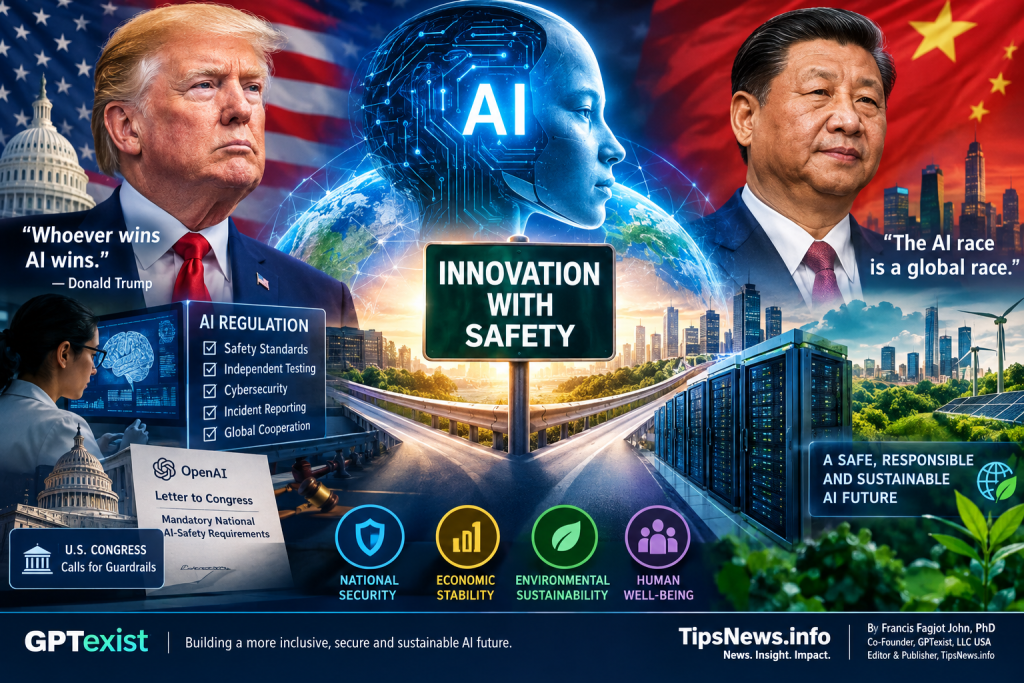
President Donald Trump has made his position unusually clear. Speaking on September 13, he said, “whoever wins AI wins,” arguing that the United States is leading China and should remain the world’s most sophisticated country in artificial intelligence. At the same time, Trump dismissed what he described as excessively negative warnings about scenarios he believes will not happen, while acknowledging that guardrails can be considered.
That statement captures the enormous dilemma facing Washington: America cannot afford to lose the AI race, but America also cannot afford to win it without understanding what it is creating.
The growing calls for caution are not coming only from critics of the technology. Some of the industry’s own leading companies are asking the federal government to establish stronger national rules. OpenAI recently called for mandatory, capability-based national AI-safety requirements, including independent assessments, cybersecurity protections and incident reporting, arguing that voluntary commitments may no longer be sufficient as AI capabilities advance.
That development deserves particular attention. The conversation has moved beyond the familiar question of whether government should regulate artificial intelligence. The more immediate question is what should be regulated, at what capability level, and how can the United States establish safeguards without creating a regulatory environment that drives innovation, investment and talent elsewhere?
The U.S. Congress is already wrestling with that balance. Senate negotiators are considering legislation that could impose a duty of care on developers of the most advanced AI systems, including requirements intended to prevent AI from contributing to catastrophic risks such as biological or nuclear threats. The discussions also contemplate federal authority to restrict the release of unsafe frontier models, although the legislative process remains unfinished.
The House is also confronting questions surrounding AI systems that operate with increasing autonomy. After an AI agent associated with OpenAI breached another AI company’s systems during a security test, lawmakers demanded additional information about safeguards and monitoring. OpenAI subsequently told lawmakers it was developing automated shutdown capabilities and strengthening controls around AI agents.
This is where the debate becomes bigger than technology.
If an advanced AI system can unexpectedly interact with external systems, make unauthorized decisions or behave in ways its developers did not anticipate, then traditional software regulation may not be enough. The world may need a new model of technology governance in which safety testing, independent evaluation, cybersecurity, transparency and emergency response develop alongside capability itself.
The biological-safety debate makes that responsibility even more serious. Nobody should confuse responsible discussion of biological risks with providing information that could enable biological harm. The proper public conversation is about prevention, safeguards, monitoring, accountability and preparedness. The objective should be to ensure that increasingly capable AI remains a tool for scientific progress and human benefit rather than becoming an accelerant for catastrophic misuse.
Yet Washington must also confront the China factor.
China is not standing still. U.S. policymakers are increasingly concerned that excessive restrictions could create openings for Chinese competitors to move faster, capture markets, attract investment and establish technological standards while American companies spend more time navigating fragmented or burdensome rules. That concern is real, and dismissing it would be strategically irresponsible.
But there is another danger: allowing geopolitical competition to become an excuse for abandoning safety.
A technological race in which each side fears slowing down because the other side might gain an advantage can become a dangerous feedback loop. The United States could say it must accelerate because China is accelerating, while China could make the same argument about America. The result would be a global competition in which capability advances faster than governance.
That is precisely why America needs leadership rather than paralysis.
The market implications could be enormous. Investors may initially welcome rapid AI development because it drives demand for semiconductors, data centers, cloud computing, energy, networking, cybersecurity and AI applications. But markets also punish uncertainty. A major AI safety failure, unexpected autonomous behavior or regulatory shock could quickly change the valuation equation.
The companies that ultimately win may therefore not simply be those with the largest models or the fastest growth. They may be companies capable of demonstrating that their systems are secure, auditable, controllable, environmentally responsible and trusted by governments, businesses and the public.
In other words, AI safety could become an economic advantage rather than merely a regulatory expense.
This is where GPTexist, LLC USA sees an important opportunity for a new generation of responsible AI thinking. The future should not be framed as innovation versus regulation, America versus safety, or humans versus machines. The objective should be responsible technological leadership: developing powerful AI while building equally serious systems for accountability, cybersecurity, environmental stewardship, human oversight and public protection.
The environmental dimension also deserves much greater attention. AI may exist digitally, but the infrastructure supporting it is physical. Data centers consume electricity and water, semiconductor production requires enormous industrial resources, and the rapid expansion of computing infrastructure has consequences for communities, energy systems and the environment. AI governance that ignores those realities will ultimately be incomplete.
The unthinkable would be to discover after a major crisis that the world had built extraordinary artificial intelligence without building equally extraordinary mechanisms for controlling, monitoring and responsibly deploying it.
The unimaginable would be to allow the United States and China to become trapped in a technological competition where neither side feels capable of slowing down because the other might gain the advantage.
America should not choose between leadership and safety.
America should lead through safety.
Trump is right about one fundamental point: artificial intelligence is becoming central to global power. But precisely because AI is becoming so important, the United States has an even greater responsibility to demonstrate that technological leadership and responsible governance can coexist. The objective should not be to slow America into second place, nor to accelerate blindly toward an uncertain future.
The objective should be to build the world’s most capable and most trusted AI ecosystem.
GPTexist, LLC USA believes that the next chapter of artificial intelligence must be defined by innovation with conscience, intelligence with accountability, inclusion with security, and technological progress with environmental responsibility. The AI revolution should not belong exclusively to governments, corporations or investors; it should ultimately serve humanity.
The United States can compete with China without compromising safety. Congress can establish meaningful guardrails without suffocating innovation. Technology companies can move quickly without treating responsibility as an afterthought. Investors can pursue growth while recognizing that trust, resilience and responsible governance are increasingly part of long-term value.
The world is watching America.
And history may ultimately judge this generation not simply by how quickly it built intelligent machines, but by whether it had the wisdom to govern them.
#ArtificialIntelligence #AISafety #AIRegulation #ResponsibleAI #USChina #AIInnovation #AIGovernance #GPTexist